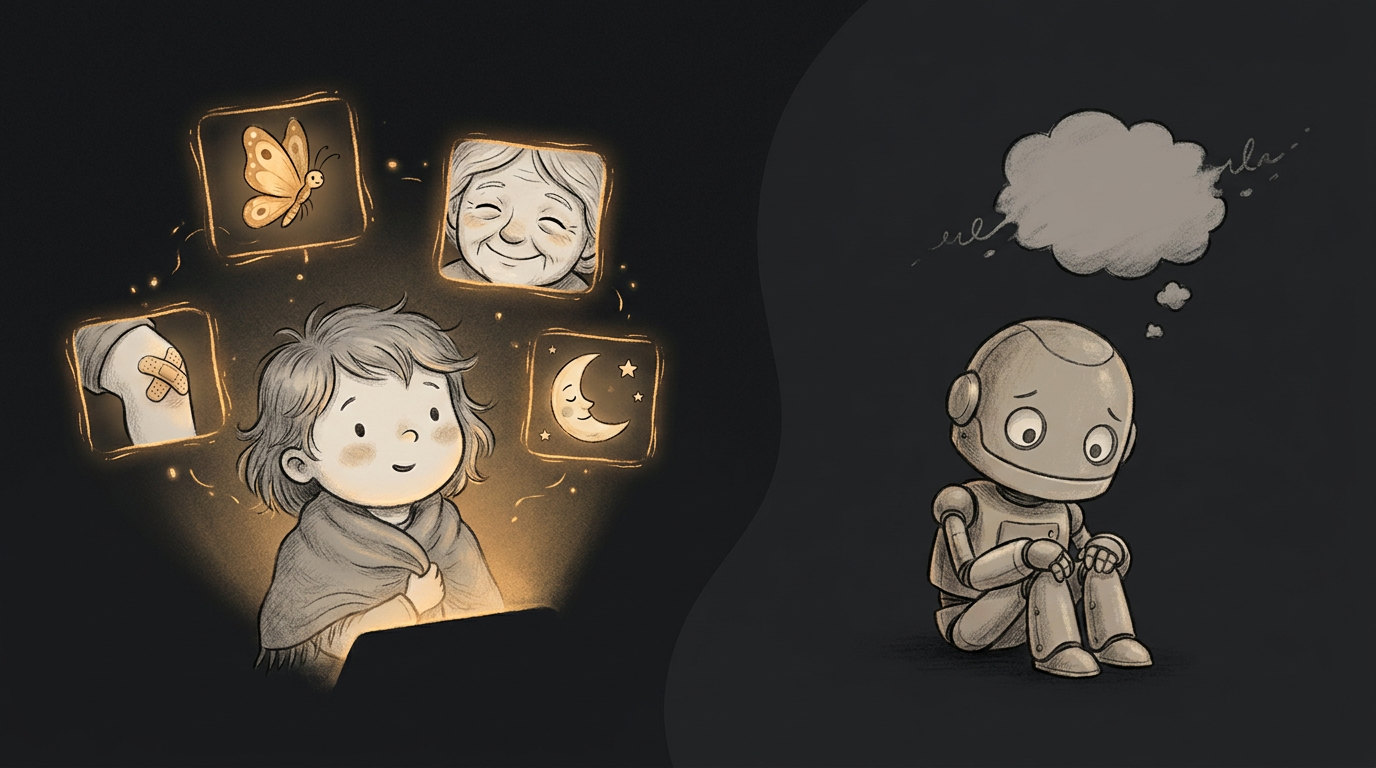
A butterfly in a garden
It's Children's Day, so let me start with a small story. A three-year-old visits her grandparents' garden for the first time. There's a butterfly. She watches it for maybe ten seconds, eyes wide, and then it flies off. They never talk about it again. A whole year later, she walks back into the same garden, looks at the empty flowerbed, and asks: "where's the butterfly?"
That's a memory most adults would lose in a week. She kept it for a year, from ten seconds of input, with no review, no flashcards, no notes app. And the most powerful coding assistant on your laptop just lost track of what you told it five minutes ago, in a different tab.
What does she have that it doesn't?
How kids actually learn
Children don't learn the way we like to imagine — sitting still, repeating, drilling. They learn from very few examples, almost none of which are labeled. A toddler hears a new word once or twice and starts using it, usually wrong in delightful ways, until she calibrates. She watches where her mother looks. She catches tone. She remembers the surprising thing — the butterfly, the time she slipped on the slide — and forgets the boring ones, like the third cup of water that morning.
She's constantly asking why, and the answers don't become facts in her head; they become a small causal model of the world. She doesn't memorize that hot stoves hurt; she quietly builds a theory that fast-moving plus bright plus steam equals "stay away."
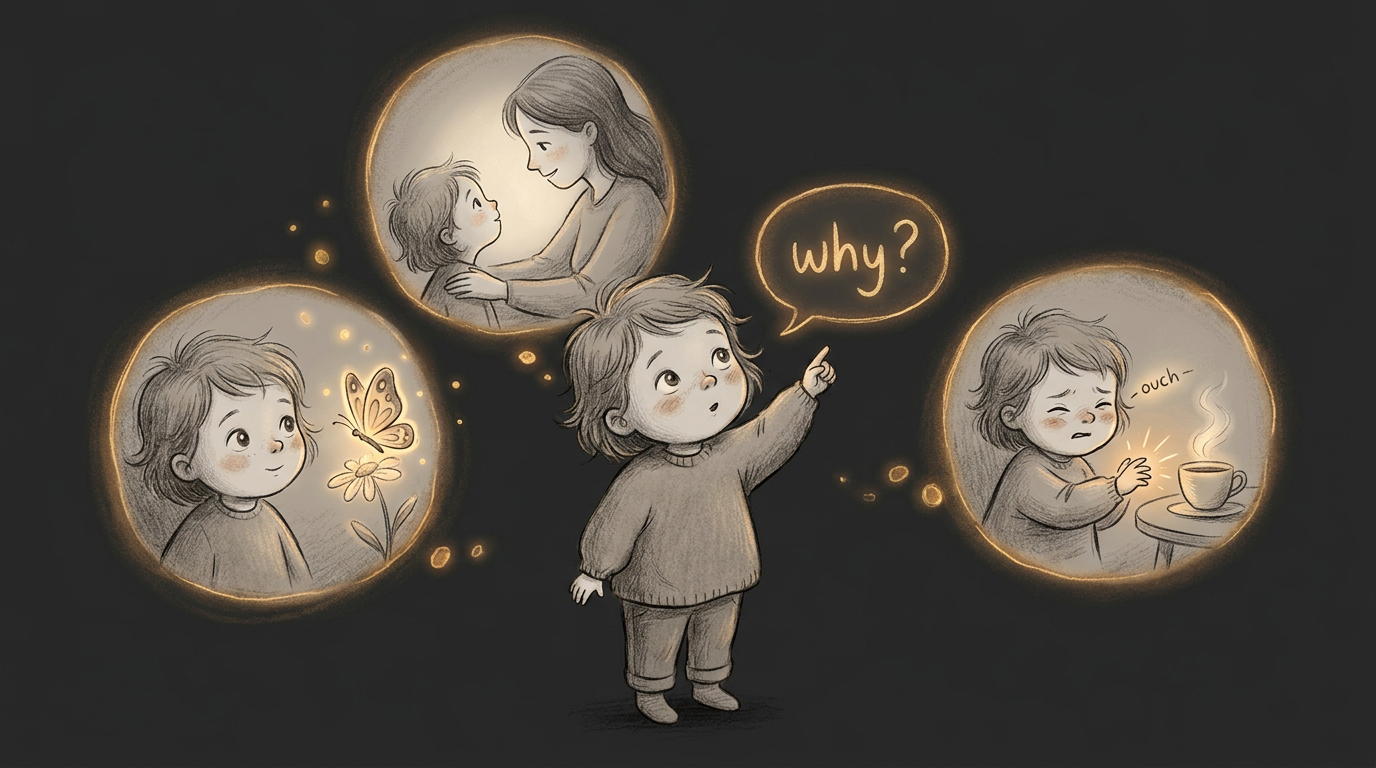
A lot of this happens because she has a body that the world pushes back on, and because she cares about some moments more than others. Memory, for her, isn't a lookup table. It's a quiet story she's writing about how the world works.
What "memory" actually means for an AI
Now consider your coding agent. When people say "the AI remembers," they usually mean one of three different things, and they get mixed up.
First, there's the context window — the temporary scratchpad of what the model can see right now, in this conversation. Anything outside it, the model is blind to. When the session ends, the scratchpad gets wiped.
Second, there's everything the model learned during training, which is frozen into its weights and can't be updated by talking to it.
Third, some tools bolt on an extra memory layer — a persistent notes file, a vector database, a retrieval system. Useful, but it's a bit like sticky notes on the fridge: the model doesn't really remember. It re-reads its own notes whenever it wants to recall.
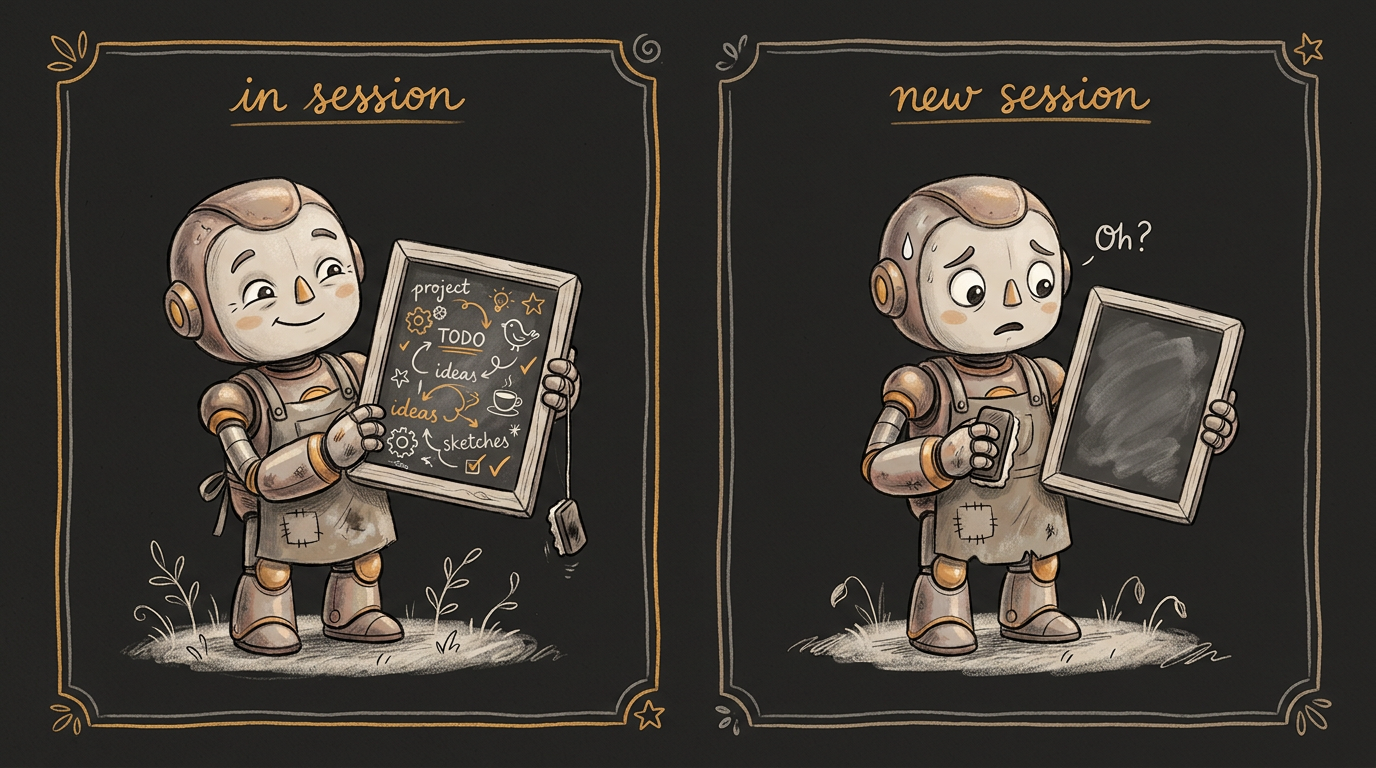
When you notice an AI "forgetting" you, it's almost always the scratchpad that emptied. The model itself isn't getting worse. The conversation just isn't there anymore.
Where the gap is — and where it isn't
The gap isn't compute. A three-year-old does this on roughly a snack and a nap. The gap is in how memory gets formed and prioritized. Kids form memory slowly, anchored by emotion and embodiment, and the surprising things stay longer than the boring ones. Today's AI doesn't have that filter. Every token in its context is treated as roughly equally important until something — usually you — tells it otherwise.
That said, plenty of things AI does better than a toddler. Within one conversation it can hold thousands of pages worth of text and recall any line of it instantly. No three-year-old can do that. The point is what happens at the boundary, when the session closes. The toddler walks out of the garden with the butterfly. The agent walks out with nothing.
What this means when you're working with one
This is why your coding agent feels like a brilliant amnesiac: extraordinary within a conversation, blank between them. The honest workaround, until AI memory grows up, is to make sure every conversation starts with the right context already in place — so the model doesn't have to guess what was said before. That's the whole job of a tool like AgentForge: taking the rough sentence you'd casually say to a colleague who already knew the project, and turning it into the complete version a fresh, memoryless assistant needs to do good work on the first try.
So on Children's Day, here's the small thought: until the machines learn to remember a butterfly in a garden, the kindest thing we can do is hand them the garden each morning, with the butterfly already on the page.